The Missing Piece: A Deep Dive Into NUS High’s Timetables
by Kyan, Penn Lun, Sze Yin, and Joseph
Every semester, we get a new schedule to complain about. But we typically see only one out of many that caters to our diverse interests and considerations. How then does the school manage our timetables?
Behind the scenes, the design of the timetables must follow some key guiding principles. Through deconstructing our timetables, finding patterns, and discussing with the teachers in charge themselves, we will attempt to uncover these underlying principles.
Behind the scenes
For scheduling, the school uses aSc timetables, a software that allows the school to generate a set of timetables from the list of classes and subjects. More importantly, it features the option to select a variety of factors to consider when creating the timetable.
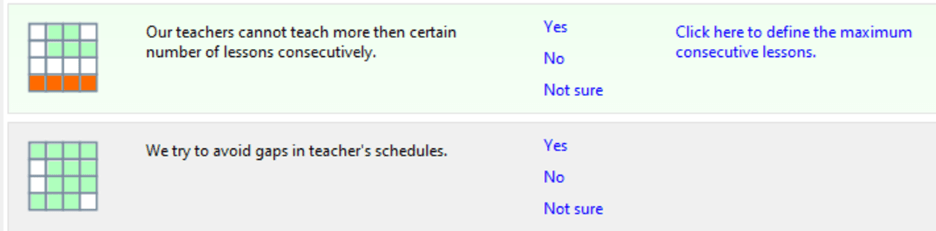
With the power of software, the school is thus able to intricately control what considerations will go into our timetable. So, what are the top priorities when it comes to timetable design?
From the creators
Mere speculation gets us nowhere. There could be a thousand reasons we could try to name till the end of time, but nothing will ever beat the information received directly from teachers who create the timetables themselves. Let’s hear about their experience.
What are your top 3 considerations in planning the timetable?
Firstly, their top three considerations are in order: the existence of a solution, prioritising physical necessities, and conducting further optimisation.
Creating a timetable for so many classes can be likened to filling in a gigantic jigsaw puzzle, making sure every piece can be fit in to produce a coherent result. Therefore, a solution must first and foremost be possible within its constraints. This includes keeping the periods that occupy fixed time slots, such as mentoring, Da Vinci and CCA, while ensuring the timetable does not stretch past 6pm. Sometimes just fitting it all is impossible, and the whole puzzle falls apart; in such scenarios, they would have to request specific changes from the relevant academic departments. This must be done iteratively until a solution can be found.
Next, the physical needs of the people. Much like a machine cannot start without electrical human, most humans seem to malfunction without proper scheduled breaks. A high priority is trying to provide a minimum of a 30 minute recess and 1 hour lunch for students at suitable times. Only then do they consider teachers, making sure there is at least “time for lunch daily”. Unlike students, they do not have protected lunch hours, which might make it hard to maintain healthy and consistent eating habits.
In contrast, students’ timetables now are designed with fixed lunch slots in mind, as all students now have at least two designated break times, namely lunch and recess throughout the course of a day. This has not always been the case. Close to a decade ago, lunch periods were far more sporadic, and there was far less restrictions guiding the distribution of our break times, until our former principal suggested and implemented this change. This change highlights an example where the school has made improvements to our timetables, changes that newer batches of students are unaware of and naturally take for granted.
When these priorities are taken care of, only then can other optimisations be considered, such as minimising the gaps between lessons to make dismissal times earlier. However, this can be challenging when there are lessons that must be banded at the same timeslot for different classes, such as honours, humanities and accelerated math. In cases where for various reasons, these lessons cannot be arranged to be at the end of the day, students who do not have the lessons will be stuck with gaps in the day. These “white spaces” are supposed to give students time to direct themselves with what they wish to do, be it self-directed learning or student meetings, however, some will have the perspective of it simply wasting their time in school and wish for lessons to be pushed into it so they could go home earlier.
As mentioned, the difficulty of making dismissal times as early as possible therefore means that some tradeoffs must be made. There are a few measures the school takes in this regard. Electives and Third Language lessons are often placed as the last modules of a day, allowing students who did not take them to be dismissed earlier. Additionally, the latest dismissal times on average are among the Year 5 timetables, with a Tuesday at 18:00 and a Thursday which potentially stretches to 18:00 should you take an elective. There is a reason for this; Year 5s are also expected to be staying in NUS High’s Boarding school, which would, in theory, balance out the late dismissals.
What are some of the difficulties faced in scheduling?
The biggest issue is considering how the timetables differ between the classes. While they aim for overall balance to ensure fairness and comfort, sometimes it is simply not possible. An improvement for one mentor group’s timetable can result in cascading negative effects on other timetables, causing them to be stuck between a rock and a hard place. They also must consider the teachers’ own timetables too.
Another key issue is information. Reusing the analogy of the jigsaw puzzle, sometimes the shapes or pictures of the pieces are unknown, and they can even suddenly disappear. This can arise from many different factors, like orders from higher-ups, not wanting teachers to have to teach for extended periods, or many other unpredictable reasons. Last-minute requests are also quite burdensome and might even result in having to rearrange other massive chunks elsewhere.
The last issue they highlighted was minimising white space for earlier dismissals. However, since certain lessons need to occur at a synchronised time between all classes, issues can crop up when they are unable to push them to the later parts of the day.
How long does it take to create the timetables from start to end?
Typically, the process starts by Week 8 of each semester till the last week at the end of school holidays. This works out to be slightly more than 4 months.
However, this includes the time required to gather the prerequisite information needed from various subject departments. The actual time spent to formulating the timetable after they have gathered the required information would be about 6 weeks.
Conclusion
So, whenever you find yourself lamenting the issues on your timetable, it never hurts to remember all the effort that goes into it to optimise it for everyone. There is no perfect solution that can meet all our needs equally and perfectly, but rest assured that the teachers behind it are trying their absolute hardest to satisfy everyone’s demands.
 nushpress